
Contents
Overview
The seeds of the Appalachian Regional Commission (ARC) were sown in the mid-20th century, a period marked by growing awareness of persistent poverty and underdevelopment in the Appalachian Mountains. Decades of resource extraction, limited industrial diversification, and geographic isolation had left many communities struggling. The Appalachian Regional Commission was established as part of President Lyndon B. Johnson’s War on Poverty initiative, championed by his administration. Congress officially established the commission through the Appalachian Regional Development Act of 1965, recognizing the need for a coordinated federal and state approach to address the region's unique challenges. Early efforts focused heavily on building basic infrastructure, particularly roads, to connect isolated communities and facilitate economic activity. The initial vision was to create a more integrated region, capable of attracting investment and fostering self-sustaining growth, moving beyond the boom-and-bust cycles of extractive industries that had long defined the area's economy. The commission's structure, a partnership between federal and state governments, was designed to ensure local buy-in and responsiveness, a model that has persisted for nearly six decades.
⚙️ How It Works
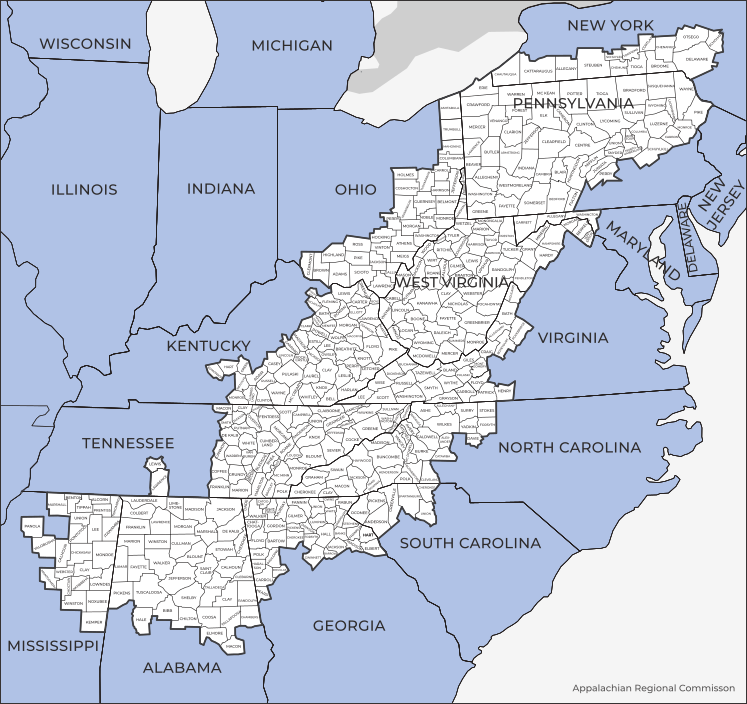
ARC operates as a unique federal-state partnership, coordinating development efforts across its 13-state region. Its core mechanism is the allocation of federal funds, matched by state and local investments, to projects that align with its strategic goals. These goals, updated periodically, typically focus on areas like broadband deployment, workforce development, transportation infrastructure, health services, and business innovation. The commission's work is guided by a strategic plan, developed through extensive consultation with stakeholders, which outlines priorities and funding opportunities. Project proposals are submitted by local entities—counties, municipalities, non-profits, and educational institutions—and are reviewed by both state Appalachian Development Highway System (ADHS) representatives and the ARC staff. The ARC Commission, comprised of the 13 state governors and the federal co-chair, makes final funding decisions, ensuring a balance between federal oversight and state-level priorities. This collaborative model aims to leverage diverse resources and expertise to tackle complex regional issues that individual states or localities might struggle to address alone.
📊 Key Facts & Numbers
The Appalachian Region, as defined by Congress, encompasses 423 counties and 8 independent cities across 13 states, covering approximately 205,000 square miles. This vast territory is home to over 25 million people, a significant portion of whom have historically faced higher rates of poverty and unemployment compared to the national average. Since its inception in 1965, ARC has invested over $4.5 billion in more than 20,000 projects across the region. In fiscal year 2023 alone, ARC invested $245 million in 171 projects, leveraging an additional $300 million in non-federal funding, totaling over $545 million in development investments. These investments have supported critical infrastructure, such as the construction and improvement of over 1,000 miles of Appalachian Development Highway System (ADHS) roads, and have been instrumental in bringing broadband internet to an estimated 1.5 million households. The economic impact is substantial, with ARC-funded projects supporting an estimated 300,000 jobs and generating billions in economic output annually.
👥 Key People & Organizations
The Appalachian Regional Commission is led by a federal co-chair, appointed by the President of the United States and confirmed by the Senate, who serves as the federal government's principal representative. The 13 state governors of the Appalachian states are the other voting members of the commission. Key figures in ARC's history include its early federal co-chairs and the governors who championed its cause. The commission's professional staff, based in Washington, D.C., manages day-to-day operations, program development, and project oversight. Numerous state-level agencies, such as West Virginia's Department of Economic Development or Pennsylvania's Department of Community and Economic Development, work closely with ARC to identify and implement regional projects. Local development districts (LDDs) also play a vital role, serving as regional planning bodies and conduits for project applications, representing entities like the New River Gorge Regional Development Authority.
🌍 Cultural Impact & Influence
ARC's influence extends beyond direct funding, shaping regional identity and fostering a sense of shared purpose among diverse Appalachian communities. Historically, the commission's focus on infrastructure, particularly the Appalachian Development Highway System (ADHS), fundamentally altered the region's connectivity, enabling greater access to markets and services, and impacting everything from tourism to commuting patterns. The commission's emphasis on workforce development has helped to retrain workers for new industries, mitigating the decline of traditional sectors like coal mining. Furthermore, ARC's support for broadband expansion is increasingly crucial in bridging the digital divide, impacting education, healthcare access through telemedicine, and the growth of remote work opportunities. By investing in community-based projects, ARC has also helped preserve cultural heritage and support local entrepreneurship, contributing to a more vibrant and resilient Appalachian identity that counters historical stereotypes of poverty and isolation. The commission's work has been a significant factor in the ongoing narrative of Appalachian revitalization.
⚡ Current State & Latest Developments
In 2024 and 2025, ARC continues to prioritize investments in broadband, workforce training, and economic diversification, adapting to emerging challenges and opportunities. A significant focus remains on leveraging technology to improve access to healthcare and education, particularly in remote areas. The commission is also increasingly emphasizing climate resilience and sustainable development, recognizing the environmental shifts impacting the region. Recent initiatives include funding for projects aimed at revitalizing former industrial sites for new economic uses and supporting the growth of the region's outdoor recreation economy. ARC is also actively working to attract private sector investment through its various grant programs, seeking to create a more sustainable economic base beyond federal funding. The ongoing implementation of the CHIPS and Science Act and other federal infrastructure initiatives presents new opportunities for ARC to coordinate and amplify its impact, ensuring that Appalachian communities benefit from national economic development trends. The commission's strategic plan for 2024-2027 outlines key performance indicators and investment priorities, guiding its efforts to foster equitable growth.
🤔 Controversies & Debates
The Appalachian Regional Commission is not without its critics and controversies. A persistent debate revolves around the effectiveness and equity of its funding distribution. Some argue that funds disproportionately benefit certain areas or industries, while others contend that the sheer scale and diversity of the region make equitable distribution a complex challenge. Questions have also been raised about the long-term sustainability of projects funded solely by grants, and whether they truly foster independent economic growth or create ongoing dependency. Critics sometimes point to the slow pace of development in certain areas, despite decades of ARC investment, suggesting that the commission's approach may not always align with the rapid pace of global economic change. Furthermore, the commission's definition of the Appalachian region itself has been a subject of discussion, with some advocating for broader inclusion or different geographical boundaries based on socioeconomic indicators rather than purely congressional designation. The balance between federal oversight and state
Key Facts
- Category
- organizations
- Type
- topic