
Contents
Overview
The conceptual roots of the Hero's Journey can be traced back to early 20th-century explorations of myth and psychology. While Joseph Campbell is credited with popularizing the term 'monomyth' in his 1949 book, The Hero with a Thousand Faces, his work built upon the theories of others. Psychoanalyst Otto Rank explored similar narrative patterns in his work 'The Myth of the Birth of the Hero,' focusing on the birth and early life of heroes. Anthropologist Lord Raglan, in his book 'The Hero: A Study in Tradition, Myth and History,' outlined characteristics common to hero myths. Crucially, Campbell was deeply influenced by the analytical psychology of Carl Jung, particularly Jung's concept of archetypes and the collective unconscious, which suggested universal patterns of human experience embedded in myths. Campbell synthesized these ideas, identifying a recurring narrative cycle that he believed represented a fundamental human psychological and spiritual journey.
⚙️ How It Works
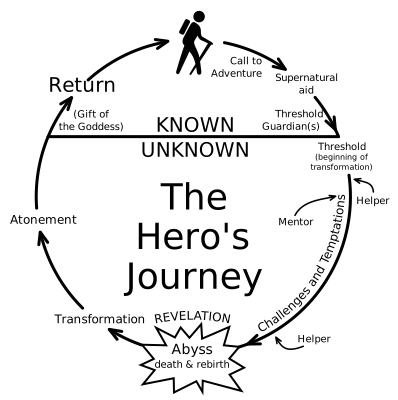
The Hero's Journey is typically depicted as a cyclical structure comprising three main stages: Departure, Initiation, and Return. The Departure begins with the 'Call to Adventure,' where the hero is presented with a challenge or quest, often initially refusing it before being spurred on by a 'Mentor' or a 'Supernatural Aid.' The hero then crosses the 'Threshold' into the special world. The Initiation phase involves the hero facing various 'Tests, Allies, and Enemies,' confronting their deepest fears, and undergoing a 'Supreme Ordeal' or 'Apotheosis.' This ordeal often leads to a 'Reward' or 'Seizing of the Sword.' The final stage, the Return, sees the hero re-crossing the Threshold back into the ordinary world, often facing a 'Resurrection' or final test, and ultimately returning with a 'Boon' or elixir to share with their community. This structure, while flexible, provides a robust framework for character development and narrative progression.
📊 Key Facts & Numbers
Joseph Campbell identified approximately 17 stages within the monomyth, though many modern interpretations condense this into fewer, more generalized steps. The concept has been applied to an estimated 80% of all stories ever told, highlighting its pervasive influence. In terms of market impact, films that adhere to this narrative structure have generated billions of dollars globally; for instance, the Marvel Cinematic Universe's overarching narrative culminated in Avengers: Endgame. The Hero's Journey framework is estimated to be used by over 90% of screenwriters in Hollywood.
👥 Key People & Organizations
The most pivotal figure is undoubtedly Joseph Campbell, whose 1949 book The Hero with a Thousand Faces codified the monomyth. His work was heavily influenced by Carl Jung, a Swiss psychiatrist who posited the existence of archetypes and the collective unconscious. Earlier contributions came from Otto Rank, a psychoanalyst and early follower of Sigmund Freud, and Lord Raglan, a British anthropologist. In contemporary media, directors like George Lucas have explicitly cited Campbell's work as a foundational influence on Star Wars, a franchise that itself has spawned numerous derivative works and analyses. Organizations like The Writers Guild of America often incorporate narrative structure training that implicitly or explicitly references the Hero's Journey.
🌍 Cultural Impact & Influence
The Hero's Journey has profoundly shaped modern storytelling, particularly in cinema and literature. Its archetypal patterns resonate deeply with audiences, providing a sense of familiarity and catharsis. George Lucas's Star Wars saga is perhaps the most famous modern example, directly applying Campbell's stages to Luke Skywalker's arc. Beyond film, the monomyth can be seen in video games like The Legend of Zelda series, where players embody a hero undertaking a grand quest. It has also influenced self-help and personal development literature, framing individual challenges as heroic journeys. The concept's ubiquity has led to its analysis in fields ranging from literary criticism and psychology to marketing and brand storytelling, demonstrating its enduring cultural power. Its influence is so widespread that it's often considered a foundational element of Western narrative tradition.
⚡ Current State & Latest Developments
In 2024, the Hero's Journey continues to be a dominant force in narrative creation, though its application is evolving. While blockbuster films like Dune: Part Two (2024) still adhere closely to the monomyth, there's a growing trend towards subverting or deconstructing its tropes. Streaming platforms like Netflix and Disney+ are increasingly commissioning stories that play with or invert the traditional hero arc, exploring anti-heroes and more complex moral landscapes. Academic discourse also continues, with new analyses emerging that apply the monomyth to emerging media like virtual reality experiences and interactive narratives. The ongoing debate centers on whether the monomyth remains a vital tool or a potentially limiting formula in an increasingly diverse and complex media ecosystem.
🤔 Controversies & Debates
The most significant controversy surrounding the Hero's Journey is its perceived universality and potential for cultural bias. Critics argue that Campbell's framework, heavily influenced by Western and Eastern mythologies, may not adequately represent narrative structures from all global cultures, potentially imposing a Western lens on diverse storytelling traditions. Some scholars, like Christina Hoff Sommers, have questioned the scientific validity of Jung's archetypes, which underpin Campbell's theory. Furthermore, the formulaic application of the monomyth in Hollywood has led to accusations of creative stagnation and predictability, with some arguing it stifles originality. The debate is whether the monomyth is a descriptive tool for understanding existing narratives or a prescriptive one that limits creative possibilities.
🔮 Future Outlook & Predictions
The future of the Hero's Journey likely involves continued adaptation and subversion. As audiences become more sophisticated, expect a greater emphasis on deconstructed and inverted monomyths, where the 'hero' might be an anti-hero, the 'boon' might be a curse, or the 'return' might be impossible. The rise of AI-generated narratives may also present new challenges and opportunities, potentially creating novel story structures or, conversely, reinforcing existing patterns like the monomyth. Experts predict that while the core archetypal journey will persist, its manifestation will become more varied and less predictable, reflecting a broader cultural shift towards nuanced and morally ambiguous protagonists. The challenge will be to innovate within or beyond the monomyth's framework to create truly resonant stories for future generations.
💡 Practical Applications
The Hero's Journey is not merely an academic concept; it's a practical tool employed across numerous creative and professional fields. Screenwriters use it as a roadmap for structuring films and television series, ensuring compelling character arcs and narrative momentum. Novelists and playwrights utilize its stages to build plot and develop characters. In game design, the monomyth provides a framework for player progression and quest design, seen in titles like The Witcher 3: Wild Hunt. Beyond entertainment, the Hero's Journey is applied in business for brand storytelling, marketing campaigns, and even leadership development, framing challenges and transformations in a relatable, heroic context. Therapists and coaches also use its principles to help individuals understand and navigate their own life challenges as personal quests.
Key Facts
- Category
- narratology
- Type
- topic