
Contents
Overview
Purchasing Power Parity (PPP) is an economic theory that suggests that a basket of goods and services should cost the same amount in any country when expressed in a common currency. This is calculated by comparing the prices of a standardized basket of goods and services across different nations, often using a benchmark like the Big Mac index. While market exchange rates fluctuate based on trade, speculation, and capital flows, PPP offers a theoretical benchmark for long-term currency valuation and is crucial for comparing economic productivity, GDP, and living standards across countries. The International Comparison Program (ICP), managed by the United Nations, is the most comprehensive global effort to collect PPP data.
🎵 Origins & History
The intellectual roots of Purchasing Power Parity stretch back to the 16th century with the Salamanca School. Martín de Azpilcueta discussed the concept of currency valuation based on its domestic purchasing power. His work provided a theoretical framework that economists like John Maynard Keynes would later build upon, distinguishing between absolute PPP (where a specific basket of goods is identical and prices are equal) and relative PPP (which focuses on changes in exchange rates mirroring changes in price differentials).
⚙️ How It Works
At its core, PPP operates by comparing the cost of a standardized basket of goods and services in different countries. The most famous, albeit informal, example is the Big Mac Index, developed by The Economist magazine, which compares the price of a McDonald's Big Mac across nations. A more rigorous approach involves extensive surveys by organizations like the OECD and the World Bank's International Comparison Program (ICP). These programs collect data on thousands of consumer goods, services, construction projects, and equipment prices. The resulting PPP exchange rate is calculated by dividing the price of the basket in one country by its price in another. For instance, if a basket costs $100 in the United States and ¥15,000 in Japan, the PPP exchange rate would be ¥150 per dollar, suggesting that ¥150 has the same purchasing power as $1.
📊 Key Facts & Numbers
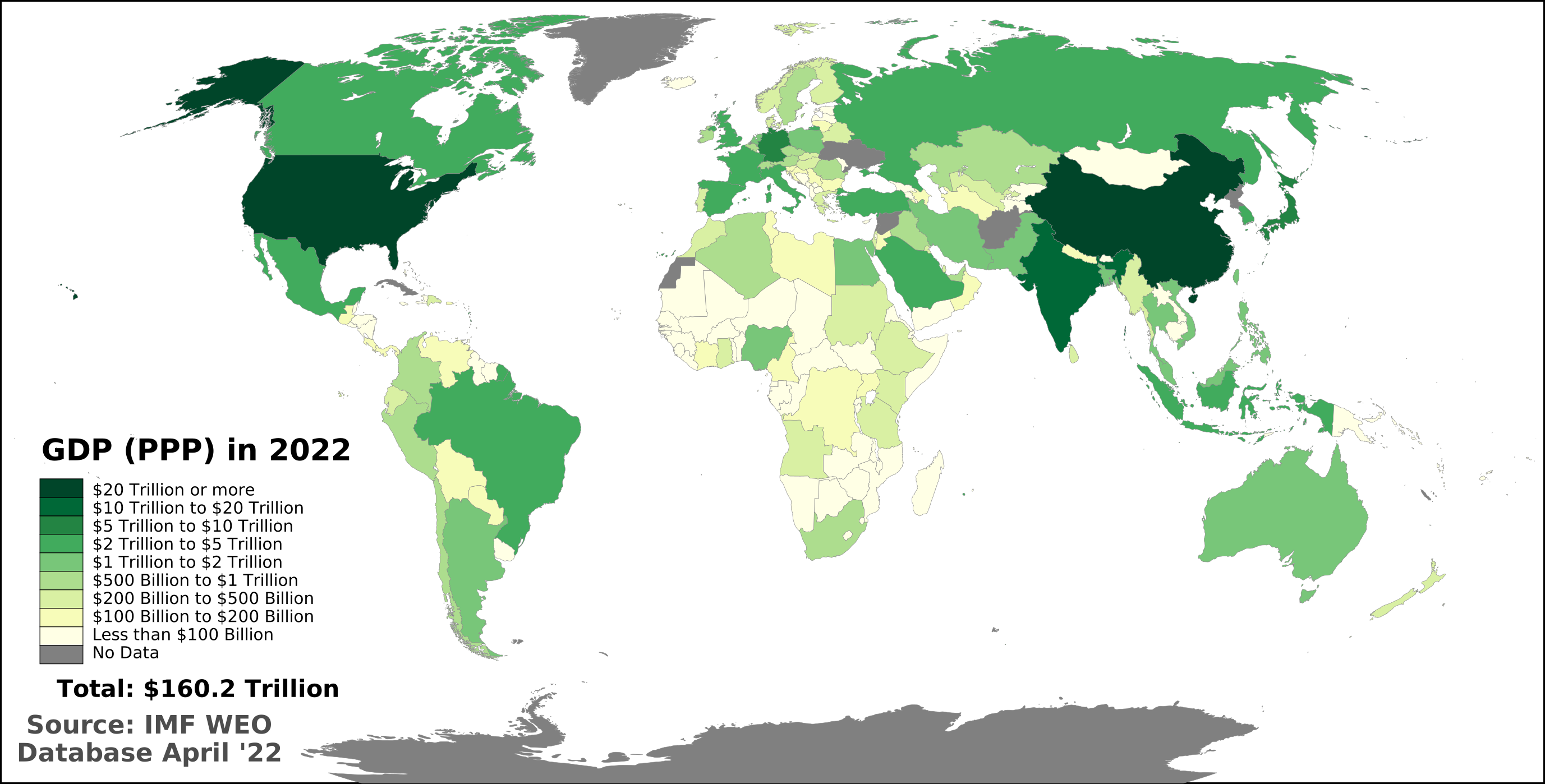
Globally, the PPP adjustment can dramatically alter perceptions of economic size. The World Bank manages the International Comparison Program (ICP). The cost of a Big Mac can range from under $2 in countries like Egypt or South Africa to over $6 in Switzerland or Norway, illustrating significant price level differences.
👥 Key People & Organizations
Key figures in the development and application of PPP include Gustav Cassel, who formalized the theory. His work was later refined by economists such as Irving Fisher and John Maynard Keynes. The OECD and the World Bank are the primary organizations responsible for collecting and publishing official PPP data through initiatives like the International Comparison Program (ICP). The Economist magazine, through its influential Big Mac Index, has popularized a simplified, albeit less rigorous, version of PPP for public understanding. Other institutions like the IMF also utilize PPP data in their economic analyses and forecasts.
🌍 Cultural Impact & Influence
PPP has profoundly influenced how we understand global economic disparities and living standards. By adjusting for price differences, it provides a more accurate comparison of the actual volume of goods and services that can be purchased with a country's income. This is critical for development economics, allowing for better assessment of poverty reduction efforts and the effectiveness of aid. For instance, comparing GDP per capita at PPP reveals that many developing nations have a higher standard of living than market exchange rates suggest. The theory also underpins discussions about globalization, trade imbalances, and the convergence of economies, suggesting that over time, exchange rates should move towards their PPP levels. The widespread use of PPP in international rankings, such as those by the United Nations and World Bank, solidifies its cultural resonance in economic discourse.
⚡ Current State & Latest Developments
The latest developments in PPP data collection are driven by the ongoing International Comparison Program (ICP). This cycle aims to incorporate more detailed price data for services and digital goods, reflecting the evolving global economy. Economists are increasingly using PPP to analyze the impact of inflation differentials and to forecast long-term exchange rate movements, especially in an era of volatile market rates influenced by geopolitical events and monetary policy shifts. Research is also focusing on the limitations of PPP in the short-to-medium term, particularly concerning the prices of non-tradable goods and services, and the impact of varying quality standards across countries. The rise of digital economies and cross-border e-commerce presents new challenges and opportunities for PPP measurement.
🤔 Controversies & Debates
A central controversy surrounding PPP is the assumption that identical goods should have identical prices in different locations after accounting for exchange rates. This rarely holds true in practice due to factors like transportation costs, tariffs, taxes, market imperfections, and differences in product quality and consumer preferences. For example, the price of a Big Mac can vary significantly due to local ingredient costs and market strategies. Critics argue that PPP is a theoretical construct that often fails to reflect real-world market exchange rates, especially in the short to medium term. Furthermore, the selection of the 'basket of goods' can be subjective and may not accurately represent the consumption patterns of all populations within a country, leading to potential biases in PPP calculations.
🔮 Future Outlook & Predictions
The future of PPP analysis will likely involve greater integration of digital economy data, including prices for online services, software, and digital content. As countries become more interconnected, the convergence towards PPP exchange rates may accelerate, though significant deviations are expected to persist due to structural economic differences and policy choices. Researchers are exploring more sophisticated econometric models to better capture the dynamics of PPP, incorporating factors like productivity differentials and the prices of non-tradable goods. The increasing availability of granular price data from online platforms and mobile devices could revolutionize PPP measurement, making it more dynamic and responsive. However, the challenge of ensuring data comparability and quality across diverse economies will remain paramount.
💡 Practical Applications
PPP has numerous practical applications beyond theoretical economics. It's essential for international organizations like the World Bank and the IMF to compare economic performance, set development aid levels, and conduct cross-country analyses. Businesses use PPP-adjusted data to assess market potential, set pricing strategies for international operations, and evaluate the cost-effectiveness of manufacturing in different locations. For individuals, understanding PPP can help in comparing the cost of living when considering international relocation or travel. It also informs policy decisions related to trade agreements, currency valuations, and the impact of global economic shocks. For example, comparing GDP per capita at PPP provides a more realistic picture of living standards than market exchange rates alone.
Key Facts
- Category
- economics
- Type
- topic