
Contents
Overview
Planetary defense is the multidisciplinary field dedicated to detecting, tracking, and mitigating the threat posed by near-Earth objects (NEOs), primarily asteroids and comets, that could potentially impact our planet. While the probability of a civilization-ending impact in any given year is exceedingly low, the catastrophic consequences necessitate proactive measures. This field integrates astronomy for detection, physics and engineering for deflection strategies, and international policy for coordinated response. Current efforts focus on cataloging NEOs, developing kinetic impactors and gravity tractors, and fostering global cooperation through organizations like the United Nations and the International Astronomical Union. The ultimate goal is to ensure humanity's long-term survival by safeguarding our planet from cosmic hazards.
🎵 Origins & History
The concept of protecting Earth from celestial threats has roots stretching back to ancient myths and early astronomical observations, but the scientific discipline of planetary defense truly began to coalesce in the late 20th century. Prior to this, early warnings and theoretical work by figures like Clark R. Chapman and David Morrison laid the groundwork for understanding NEO hazards.
⚙️ How It Works
Planetary defense operates on a multi-pronged approach. First, detection and tracking involve ground-based and space-based telescopes, like the Pan-STARRS observatory and NASA's NEOWISE mission, to identify and characterize NEOs. Once a potential threat is identified and its orbit calculated, mitigation strategies are devised. The primary methods under consideration include kinetic impactors, which involve crashing a spacecraft into the NEO to alter its trajectory, as demonstrated by the DART mission; gravity tractors, which use a spacecraft's gravitational pull to gently nudge the NEO over time; and, for larger threats or with sufficient warning, nuclear devices, though this remains highly controversial. The effectiveness of these methods depends heavily on the NEO's size, composition, and the amount of lead time available.
📊 Key Facts & Numbers
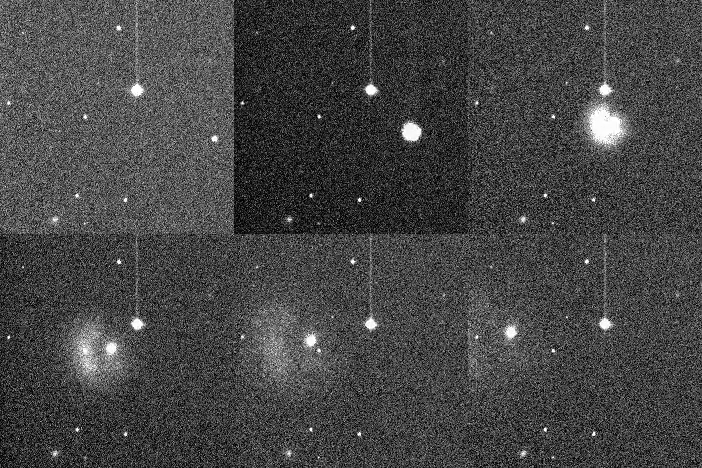
The Double Asteroid Redirection Test (DART) mission, launched in 2021, successfully impacted the asteroid Dimorphos in September 2022, altering its orbit by 32 minutes, a key validation of kinetic impactor technology.
👥 Key People & Organizations
Several key individuals and organizations drive the field of planetary defense. Ed Lu, a former astronaut, co-founded the B612 Foundation to advocate for NEO detection and mitigation. Lindley Johnson has been a pivotal figure at NASA, leading its Planetary Defense Coordination Office. International bodies like the United Nations Office for Outer Space Affairs (UNOOSA) and the International Asteroid Warning Network (IAWN) facilitate global cooperation and information sharing. Major space agencies, including NASA, the European Space Agency (ESA), and China National Space Administration (CNSA), are actively involved in NEO surveys and developing mitigation technologies. The Planetary Defense Conference, held biennially, brings together scientists and policymakers to discuss the latest findings and strategies.
🌍 Cultural Impact & Influence
Planetary defense has permeated popular culture, often serving as the central theme for blockbuster films that explore humanity's response to impending doom. These narratives, while dramatic, have also contributed to public awareness and support for scientific endeavors in this field. The fictional scenarios often highlight the need for international cooperation and rapid technological advancement, mirroring real-world challenges. The cultural resonance of these stories underscores humanity's deep-seated fear of cosmic annihilation and our innate drive for survival.
⚡ Current State & Latest Developments
ESA's Hera mission, a follow-up to DART, will conduct a detailed reconnaissance of the Didymos-A asteroid system to analyze the impact crater and the effects of the kinetic impact. The establishment of dedicated national offices, like NASA's Planetary Defense Coordination Office, signifies a maturing commitment to this critical area of space science and security.
🤔 Controversies & Debates
Significant controversies surround planetary defense, particularly concerning the use of nuclear devices for deflection, which raises ethical and political questions about weaponization of space and the potential for unintended consequences. The debate over resource allocation is also prominent: critics argue that the vast sums spent on planetary defense could be better utilized addressing more immediate terrestrial problems like climate change or poverty.
🔮 Future Outlook & Predictions
The future of planetary defense hinges on continued investment in detection systems and the development of a robust suite of mitigation technologies. Experts predict that within the next decade, we will have cataloged the vast majority of NEOs large enough to cause regional devastation. The focus will likely shift towards refining deflection techniques for different types of asteroids and developing rapid response capabilities. International collaboration will become even more crucial, potentially leading to a unified global agency for planetary defense. There's also speculation about leveraging advanced propulsion systems or even asteroid mining technologies for defensive purposes, though these remain speculative. The ultimate goal is to move from a reactive posture to a proactive, sustainable system of planetary stewardship.
💡 Practical Applications
Planetary defense has direct practical applications beyond preventing global catastrophes. The technologies developed for NEO detection, such as advanced optics and sensor systems, find use in other astronomical research and Earth observation applications. Orbital mechanics and trajectory analysis are critical for satellite operations, space debris management, and future space exploration missions. Furthermore, the international cooperation fostered by planetary defense initiatives can serve as a model for addressing other global challenges. The data gathered from studying asteroid composition and structure also provides invaluable insights into the early solar system and the origins of life on Earth, contributing to fundamental scientific understanding.
Key Facts
- Category
- science
- Type
- topic