
Contents
- 🎵 Origins & History
- ⚙️ How It Works
- 📊 Key Facts & Numbers
- 👥 Key People & Organizations
- 🌍 Cultural Impact & Influence
- ⚡ Current State & Latest Developments
- 🤔 Controversies & Debates
- 🔮 Future Outlook & Predictions
- 💡 Practical Applications
- 📚 Related Topics & Deeper Reading
- Frequently Asked Questions
- References
- Related Topics
Overview
The conceptual seeds of phase space were sown in the late 19th century, a period of intense development in thermodynamics and statistical mechanics. Ludwig Boltzmann, in his work on the kinetic theory of gases around the 1870s, began to visualize the states of gas molecules in terms of their positions and velocities. However, it was Josiah Willard Gibbs who, in his 1902 treatise 'Elementary Principles in Statistical Mechanics', formally introduced the term 'phase space' and solidified its definition. He described it as a space whose coordinates are the generalized positions and momenta of the system's constituent particles. Prior to Gibbs, Henri Poincaré had also made significant contributions to the understanding of dynamical systems and their geometric representations, particularly in his work on the three-body problem, hinting at the complex trajectories that would later be visualized in phase space. The development was driven by the need to statistically describe the behavior of systems with a vast number of particles, moving beyond deterministic tracking of individual components.
⚙️ How It Works
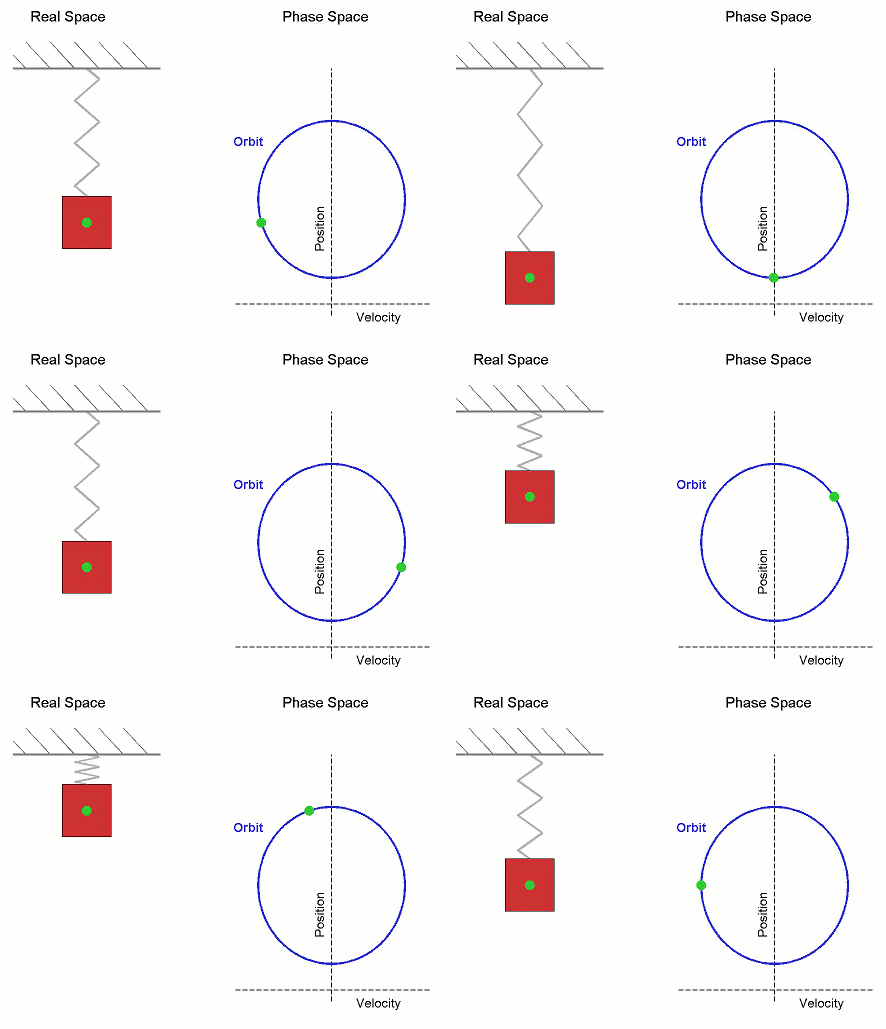
At its core, phase space is a geometric construct where each axis represents a generalized coordinate or its conjugate momentum. For a simple mechanical system with 'n' degrees of freedom, its phase space is a 2n-dimensional manifold. For instance, a single particle moving in three dimensions has 3 position coordinates (x, y, z) and 3 momentum coordinates (px, py, pz), resulting in a 6-dimensional phase space. A point in this space, (x, y, z, px, py, pz), uniquely defines the instantaneous state of the particle. As the system evolves over time according to the laws of physics (e.g., Hamilton's equations), this point traces a trajectory through phase space. This trajectory is deterministic in classical mechanics; two systems starting at infinitesimally close points in phase space will follow paths that diverge only slightly, a concept crucial for understanding chaos theory.
📊 Key Facts & Numbers
A single particle in 1D has a 2-dimensional phase space (position and momentum). A system of N particles in 3D has a phase space of 6N dimensions; for a mole of gas (approximately 6.022 x 10^23 particles), this would theoretically be a space with over 10^24 dimensions. The volume of phase space occupied by a system is conserved under Hamiltonian evolution, a principle known as Liouville's theorem. In quantum mechanics, the Heisenberg uncertainty principle imposes a fundamental limit on the precision with which position and momentum can be known simultaneously, effectively imposing a minimum 'volume' of h^n (where h is Planck's constant and n is the number of degrees of freedom) for each quantum state in phase space. This quantization means that phase space is not infinitely divisible at the quantum level.
👥 Key People & Organizations
The foundational figures in the development of phase space are Josiah Willard Gibbs (1839-1903), who formally defined and named it in his 1902 work, Henri Poincaré (1854-1912), whose work on celestial mechanics revealed the complex dynamics representable in such spaces, and Ludwig Boltzmann (1844-1906), whose statistical approach to thermodynamics laid the groundwork for understanding systems with many degrees of freedom. Later, John von Neumann (1903-1957) developed the mathematical formalism for quantum mechanics using Hilbert spaces, which can be seen as a quantum analogue to classical phase space. Key institutions like Yale University, where Gibbs taught, and the University of Paris, where Poincaré worked, were crucial environments for these developments.
🌍 Cultural Impact & Influence
Phase space has profoundly influenced how scientists visualize and understand complex systems. Its geometric interpretation allows for intuitive grasp of otherwise abstract dynamics, impacting fields from celestial mechanics to fluid dynamics. The concept of deterministic chaos, visualized as complex, fractal-like structures within phase space (e.g., strange attractors), has permeated popular science and philosophy, challenging deterministic worldviews. The idea that a system's entire history and future can be mapped as a trajectory in a high-dimensional space has resonated beyond physics, influencing cybernetic models and theories of computation. The visual language of phase space trajectories has become a standard tool in scientific literature and education.
⚡ Current State & Latest Developments
In contemporary physics, phase space remains a cornerstone for analyzing complex systems. Researchers in nonlinear dynamics and chaos theory continue to map intricate phase space structures like strange attractors to understand phenomena such as turbulence in fluid dynamics and the behavior of plasmas. In quantum computing, the concept is being adapted to describe the states of qubits, though the implications of the uncertainty principle make a direct classical phase space mapping challenging. New computational techniques are enabling the visualization and analysis of phase spaces for systems with an unprecedented number of degrees of freedom, pushing the boundaries of simulation and prediction in fields like molecular dynamics and cosmology.
🤔 Controversies & Debates
One ongoing debate revolves around the interpretation of phase space in quantum mechanics. While Gibbs's classical phase space is continuous, the Heisenberg uncertainty principle suggests a fundamental discreteness. This has led to concepts like Wigner quasi-probability distributions and F-G-H representations, which attempt to map quantum states onto a phase-space-like formalism while respecting quantum constraints. Another point of discussion is the practical limit of simulating high-dimensional phase spaces; for systems with millions of particles, direct simulation becomes computationally intractable, leading to the development of approximation methods and reduced-order models. The philosophical implications of deterministic vs. probabilistic descriptions of reality, often debated through the lens of phase space trajectories, also remain a point of contention.
🔮 Future Outlook & Predictions
The future of phase space analysis likely lies in its integration with advanced computational methods and machine learning. As computational power grows, simulations of increasingly high-dimensional phase spaces will become feasible, potentially unlocking new insights into complex phenomena like protein folding or the early universe. Researchers are exploring how AI can identify patterns and structures within phase space that are not apparent to human analysts, accelerating the discovery of new physical laws or system behaviors. Furthermore, the application of phase space concepts to fields outside traditional physics, such as economics, neuroscience, and social systems, is expected to expand, offering new frameworks for understanding complex, emergent behaviors in diverse domains.
💡 Practical Applications
Phase space is not merely a theoretical construct; it has direct applications across scientific disciplines. In astronomy, it's used to model the orbits of celestial bodies and the dynamics of star clusters. In engineering, particularly in control systems and robotics, phase space analysis helps predict and stabilize the behavior of dynamic machinery. Statistical mechanics relies heavily on phase space to derive macroscopic properties of matter from the microscopic behavior of its constituent particles, forming the basis for understanding thermodynamics. In signal processing, phase space reconstruction is used to analyze and denoise time-series data, revealing underlying dynamics that might otherwise be obscured. Even in biophysics, it aids in understanding the conformational changes of molecules like DNA and proteins.
Key Facts
- Year
- 1870s-1902
- Origin
- United States / France
- Category
- science
- Type
- concept
Frequently Asked Questions
What exactly is phase space?
Phase space is an abstract mathematical space where each point represents a unique, complete state of a physical system. For classical mechanical systems, this state is defined by all the generalized positions and corresponding momenta of its constituent parts. Imagine a map where every possible configuration and motion of a system at a single instant is plotted as a distinct location. The dimensions of this space are twice the number of degrees of freedom of the system, meaning even simple systems can occupy very high-dimensional phase spaces.
Why is phase space important in physics?
Phase space is crucial because it provides a geometric framework to visualize and analyze the evolution of dynamical systems. Instead of tracking individual particles, physicists can observe the trajectory of a single point representing the entire system's state. This allows for the study of long-term behavior, stability, and the emergence of complex phenomena like chaos, as described by Liouville's theorem and visualized through concepts like strange attractors. It's the bedrock of statistical mechanics, enabling the derivation of macroscopic properties from microscopic behavior.
How does quantum mechanics change the idea of phase space?
In quantum mechanics, the Heisenberg uncertainty principle fundamentally alters the classical notion of phase space. It states that one cannot simultaneously know both the exact position and exact momentum of a particle. This implies that phase space is not infinitely divisible at the quantum level; there's a minimum 'cell' size, related to Planck's constant, that each quantum state occupies. This quantization means that a quantum system cannot be represented by a single point in the classical sense, leading to the development of quantum phase space distributions like the Wigner quasi-probability distribution.
Can you give an example of phase space in action?
Consider a simple pendulum. Its state can be described by its angle (position) and its angular velocity (related to momentum). Its phase space is a 2D plane with axes for angle and angular velocity. A pendulum at rest at the bottom would be a point at the origin. As it swings, the point traces a path. A frictionless pendulum would trace a closed loop, representing periodic motion. A damped pendulum would trace a spiral inwards towards the rest point, showing its decay. A chaotic pendulum, however, might trace a complex, non-repeating path within a bounded region of its phase space.
What are 'strange attractors' and how do they relate to phase space?
Strange attractors are geometric shapes within phase space that represent the long-term behavior of chaotic dynamical systems. Despite the system's inherent unpredictability, its trajectory in phase space will eventually settle onto this attractor. These attractors often have fractal structures, meaning they exhibit self-similarity at different scales, and trajectories on them are highly sensitive to initial conditions. Famous examples include the Lorenz attractor and the Rössler attractor, which visualize the complex, yet bounded, dynamics of weather patterns and chemical reactions, respectively.
How is phase space used in fields outside of physics?
The principles of phase space analysis are increasingly applied to complex systems in other domains. In neuroscience, it's used to model the firing patterns of neurons and the dynamics of brain activity. In economics, phase space can help visualize market fluctuations and predict economic cycles. Engineering uses it for control system design and robotics to ensure stable operation. Even in biology, it aids in understanding molecular dynamics and population dynamics. The core idea is to represent the state of any complex system as a point in a multi-dimensional space and track its evolution.
What is the dimensionality of phase space for a complex system like a gas?
The dimensionality of phase space grows exponentially with the number of particles. For a single particle moving in three dimensions, the phase space is 6-dimensional (3 position coordinates + 3 momentum coordinates). For a system of N particles in 3D, the phase space is 6N-dimensional. This means that for a macroscopic system like a mole of gas, containing approximately 6.022 x 10^23 particles, the phase space would theoretically have over 10^24 dimensions. This immense dimensionality is why statistical methods, rather than direct tracking, are essential for understanding such systems.