
Contents
Overview
The genesis of the cutting plane method can be traced back to the seminal work of Ralph E. Gomory in 1958, who introduced the first algorithm for solving integer linear programs using these techniques. Prior to Gomory's breakthrough, solving ILPs was largely a matter of brute-force enumeration or ad-hoc heuristics, making large-scale problems computationally infeasible. Gomory's insight was to leverage the machinery of linear programming (LP) by solving the LP relaxation of an integer program and then, if the solution was not integer, systematically adding a linear inequality (a cut) that excluded the current non-integer solution while guaranteeing that all valid integer solutions remained feasible. This iterative process, often visualized as 'cutting off' parts of the feasible region, provided a rigorous mathematical framework for finding exact integer solutions. Early implementations were often slow, but the theoretical foundation laid by Gomory proved revolutionary.
⚙️ How It Works
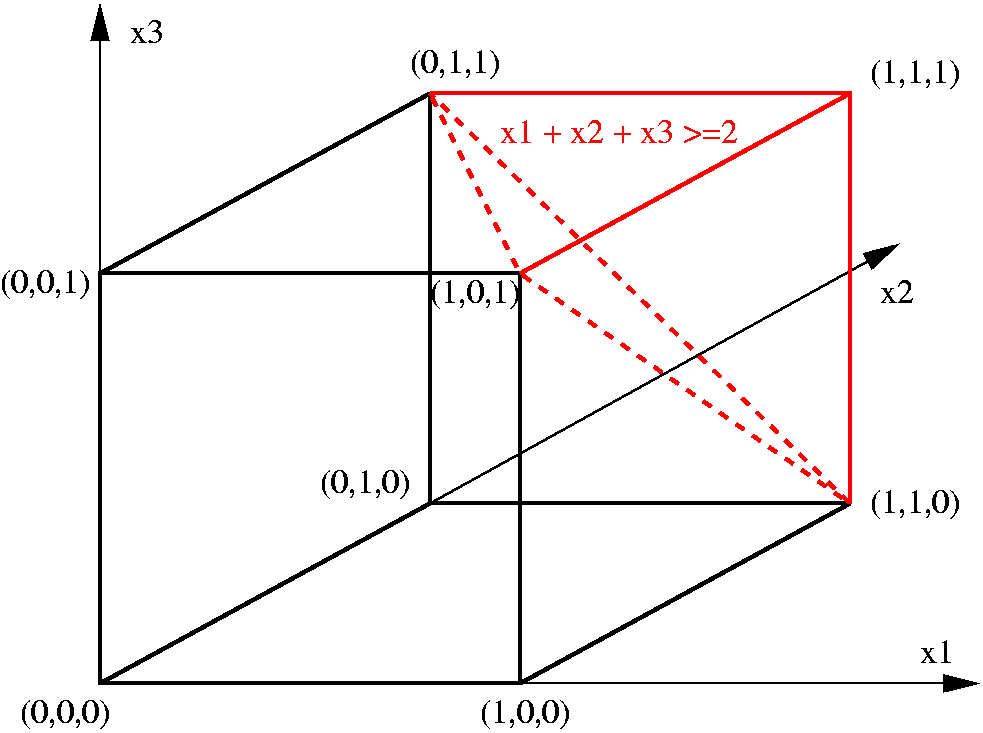
At its core, the cutting plane method operates by solving a sequence of linear programming relaxations. For an integer program, the first step is to solve its LP relaxation, which ignores the integer constraints. If the optimal solution to this LP relaxation happens to be integer-valued for all variables, then it is also the optimal solution to the original integer program. However, if the solution contains fractional values, a cutting plane is generated. This cut is a linear inequality that is satisfied by all integer feasible solutions but is violated by the current fractional optimal solution of the LP relaxation. By adding this cut to the LP problem, the feasible region is reduced, and a new LP is solved. This process repeats: solve LP, check for integer solution, if not, generate and add a cut, until an integer-optimal solution is found. The effectiveness of the method hinges on the efficiency of cut generation and the number of cuts required.
📊 Key Facts & Numbers
The computational burden of solving MILPs can be immense, with problem sizes often measured in millions of variables and constraints. The CPLEX and Gurobi optimization solvers, industry-standard tools, can handle MILPs with billions of dollars in potential value, demonstrating the scale at which these methods are applied. The efficiency gains from advanced cutting plane algorithms have been substantial, reducing solution times for complex problems from days to minutes or even seconds.
👥 Key People & Organizations
The undisputed pioneer of the cutting plane method for integer programming is Ralph E. Gomory, whose 1958 paper laid the theoretical groundwork. Gomory spent much of his career at IBM. Other significant contributors include George B. Dantzig, often credited with developing the simplex method for linear programming, which is the bedrock upon which cutting plane methods build. Modern implementations and advancements are driven by researchers and developers at leading optimization software companies like IBM (with CPLEX), Gurobi Optimization (with Gurobi), and FICO (with Xpress Optimization), as well as academic institutions worldwide.
🌍 Cultural Impact & Influence
The cutting plane method has profoundly influenced the field of operations research and industrial engineering, enabling the precise optimization of complex systems that were previously intractable. Its theoretical elegance and practical success have permeated decision-making processes across numerous industries, from supply chain management and airline scheduling to financial portfolio optimization and resource allocation. The ability to guarantee optimal integer solutions has fostered trust and widespread adoption of mathematical optimization techniques. Furthermore, the development of sophisticated cutting plane algorithms has spurred advancements in computational mathematics and algorithm design, influencing other areas of computer science.
⚡ Current State & Latest Developments
In recent years, the cutting plane method continues to be a vital component of modern MILP solvers, often integrated with other techniques like branch-and-bound. Research is actively focused on developing more effective and computationally cheaper cuts, particularly for specific problem classes like those arising in machine learning or network design. Hybrid approaches, combining cutting planes with machine learning to predict good cuts or guide the search, are also gaining traction. The ongoing challenge is to balance the power of strong cuts with the computational cost of generating and processing them, especially for ever-larger and more complex real-world problems encountered in areas like deep learning model optimization.
🤔 Controversies & Debates
While highly effective, the cutting plane method is not without its criticisms and debates. A primary concern is the potential for a very large number of cuts to be generated, leading to computational inefficiency and slow convergence. The choice of which cuts to generate and when to add them can significantly impact performance, leading to ongoing research into 'stronger' or 'more effective' cuts. Some argue that for certain problem structures, alternative methods like branch-and-bound or heuristic algorithms might converge faster, especially when near-optimal solutions are acceptable. The theoretical guarantees of optimality can sometimes come at the cost of practical speed for extremely large instances.
🔮 Future Outlook & Predictions
The future of the cutting plane method is likely to involve deeper integration with machine learning and artificial intelligence. Researchers are exploring how AI can assist in selecting or generating cuts, potentially learning from past problem-solving experiences to accelerate convergence. Furthermore, as MILP models become larger and more complex, driven by applications in areas like reinforcement learning and advanced analytics, the demand for more efficient and scalable cutting plane algorithms will only increase. Expect continued innovation in cut generation strategies and hybrid solution approaches that combine the strengths of various optimization techniques to tackle the next generation of computational challenges.
💡 Practical Applications
The practical applications of the cutting plane method are vast and touch nearly every industry that relies on optimization. In logistics, it's used for vehicle routing problems and warehouse optimization. Airlines employ it for crew scheduling and flight planning, ensuring efficient use of resources and adherence to complex regulations. Financial institutions use it for portfolio optimization, risk management, and resource allocation. Manufacturing industries leverage it for production planning and inventory control. Even in telecommunications, it aids in network design and capacity planning. Essentially, any scenario requiring discrete decisions within a complex system can potentially benefit from this method.
Key Facts
- Category
- technology
- Type
- concept