
Contents
- 💡 What is a CT Scan?
- 👨⚕️ Who Performs CT Scans?
- ⚙️ How Does a CT Scanner Work?
- 🌟 Why Choose CT Over Other Scans?
- 📈 The Evolution of CT Technology
- 🔬 Applications of CT Scans
- ⚠️ Risks and Considerations
- 💲 Cost and Insurance
- 📅 Preparing for Your Scan
- 📍 Finding a CT Scan Provider
- Frequently Asked Questions
- Related Topics
Overview
The Computed Tomography (CT) scan, often simply called a CT or CAT scan, is a diagnostic imaging procedure that uses a series of X-ray images taken from different angles around your body and uses computer processing to create cross-sectional images (slices) of the bones, blood vessels, and soft tissues inside your body. Unlike a standard X-ray, which provides a flat, two-dimensional image, a CT scan offers detailed, three-dimensional views, revealing structures and anomalies that might otherwise be obscured. It's a workhorse in modern medicine, crucial for diagnosing everything from fractures and internal bleeding to tumors and vascular diseases. Its development marked a significant leap in non-invasive diagnostics, fundamentally changing how clinicians visualize the human interior.
💡 What is a CT Scan?
A computed tomography (CT) scan is a sophisticated medical imaging technique that generates detailed, cross-sectional views of the body's internal structures. Unlike a standard X-ray which provides a flat, two-dimensional image, a CT scan uses a series of X-ray beams taken from various angles around the body. These beams are then processed by a computer to create highly detailed slices, or tomograms, revealing soft tissues, blood vessels, and bones with remarkable clarity. This makes it an indispensable tool for diagnosing a wide range of medical conditions, from bone fractures to complex tumors, offering a depth of information that traditional radiography cannot match.
👨⚕️ Who Performs CT Scans?
The individuals responsible for operating the complex machinery and acquiring the images during a CT scan are known as radiographer or radiology technologists. These highly trained professionals are experts in radiation safety, patient positioning, and the technical operation of the CT scanner. They play a crucial role in ensuring the quality and diagnostic accuracy of the images produced, while also prioritizing patient comfort and safety throughout the procedure. Their expertise is fundamental to the successful execution of any CT imaging examination.
⚙️ How Does a CT Scanner Work?
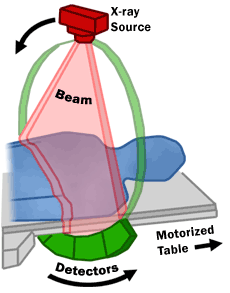
At its heart, a CT scanner is a marvel of engineering that combines X-ray technology with advanced computing. The core components include a rotating X-ray tube and a sophisticated array of detectors housed within a large, donut-shaped structure called a gantry. As the gantry rotates around the patient, the X-ray tube emits beams that pass through the body, with the detectors measuring how much the X-rays are attenuated (weakened) by different tissues. These thousands of measurements are then fed into a powerful computer, which employs complex CT reconstruction algorithms to assemble them into precise cross-sectional images.
🌟 Why Choose CT Over Other Scans?
CT scans offer distinct advantages over other imaging modalities, particularly MRI. While MRI excels at visualizing soft tissues, CT is often the preferred choice for patients with metallic implants, such as hip replacement or pacemakers, where the strong magnetic fields of an MRI can pose a significant risk. Furthermore, CT scans are considerably faster than MRI, making them ideal for emergency situations like stroke diagnosis or trauma assessment where rapid imaging is critical. The ability to visualize bone detail is also superior with CT.
📈 The Evolution of CT Technology
The journey of CT technology began with the first commercial scanner developed by Godfrey Hounsfield and James Ambrose at EMI in 1972, earning them the Nobel Prize in Physiology or Medicine in 1979. Early CT scanners were slow, producing only a single slice per scan, and required hours to complete. Over the decades, advancements have led to multi-detector CT (MDCT) scanners capable of acquiring dozens or even hundreds of slices simultaneously. This has dramatically reduced scan times, improved image resolution, and enabled techniques like CT angiography and 4D CT imaging.
🔬 Applications of CT Scans
The diagnostic utility of CT scans spans a vast array of medical specialties. In neurology, CT is vital for detecting brain hemorrhage, tumors, and signs of stroke. Orthopedics relies on CT for detailed visualization of complex bone fractures and joint abnormalities. In oncology, CT scans are used for staging cancers, monitoring treatment response, and guiding biopsy. The abdomen and pelvis are frequently imaged with CT to diagnose conditions affecting organs like the liver, kidneys, and intestines, and to identify abdominal aortic aneurysm.
⚠️ Risks and Considerations
While CT scans are incredibly valuable, they are not without risks. The primary concern is exposure to ionizing radiation, as CT scanners use X-rays. Although the dose is carefully managed by technologists and radiologists, cumulative exposure over time can increase the risk of developing cancer. For this reason, CT scans are generally used when the diagnostic benefit is believed to outweigh the potential risks. Contrast agents, often used to enhance image clarity, can also cause allergic reactions or affect kidney function in susceptible individuals.
💲 Cost and Insurance
The cost of a CT scan can vary significantly depending on the facility, the specific type of scan performed, and whether contrast material is used. In the United States, a single CT scan can range from a few hundred dollars to several thousand dollars. Health insurance plans typically cover medically necessary CT scans, but patients should always verify their coverage and understand their deductible and co-payment responsibilities with their provider and insurance company. Some facilities may offer payment plans or cash discounts.
📅 Preparing for Your Scan
Preparing for a CT scan usually involves a few straightforward steps to ensure the best possible image quality and patient safety. You may be asked to fast for several hours before the scan, especially if abdominal imaging is planned, to prevent interference from food in the stomach. It's crucial to inform your doctor and the technologist about any allergies, especially to iodine-based contrast materials, and any existing medical conditions, such as diabetes or kidney disease. You'll likely be asked to change into a hospital gown and remove any metal objects that could interfere with the scan.
📍 Finding a CT Scan Provider
Finding a reputable provider for your CT scan involves considering factors like the facility's accreditation, the experience of their radiology department, and proximity. Major hospitals and dedicated imaging center are common locations. When choosing, look for centers accredited by organizations like The Joint Commission or the American College of Radiology. Reading patient reviews and asking your referring physician for recommendations can also guide your decision. Ensure the facility uses modern CT technology for optimal diagnostic accuracy.
Key Facts
- Year
- 1972
- Origin
- EMI Central Research Laboratories, UK
- Category
- Medical Imaging
- Type
- Medical Technology
Frequently Asked Questions
Is a CT scan painful?
No, a CT scan is generally a painless procedure. You will lie on a table that moves through the scanner. The scanner itself makes some whirring and clicking noises, but there is no physical discomfort associated with the X-ray beams. If contrast dye is used, you might feel a brief warming sensation or a metallic taste in your mouth.
How long does a CT scan take?
The actual scanning time for a CT scan is very quick, often lasting only a few minutes. However, the entire process, including preparation, positioning, and the scan itself, can take anywhere from 10 to 30 minutes. More complex scans or those requiring contrast may take slightly longer.
Can I move during a CT scan?
It is crucial to remain as still as possible during the CT scan. Movement can blur the images, making them difficult for the radiologist to interpret and potentially requiring the scan to be repeated. The technologist will instruct you on when to hold your breath, if necessary.
What is the difference between a CT scan and an X-ray?
A standard X-ray produces a single, flat, two-dimensional image of the body. A CT scan, on the other hand, uses multiple X-ray beams from different angles to create detailed cross-sectional, or 'slice,' images of the body, providing much more depth and detail of internal structures.
Are there side effects from CT scans?
The main concern with CT scans is exposure to ionizing radiation. While the dose is carefully controlled, repeated exposure over many years can increase cancer risk. Side effects can also occur from contrast agents, including allergic reactions or temporary kidney strain. Your doctor will weigh these risks against the benefits of the scan.
Can I eat or drink before a CT scan?
Often, you will be asked to fast for 4-6 hours before a CT scan, especially if the scan involves your abdomen or pelvis. This is to ensure that food or liquid in your digestive tract doesn't interfere with the image clarity. Always follow the specific instructions provided by the imaging facility.