
Contents
Overview
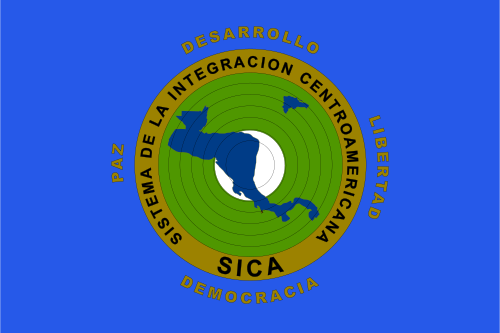
The genesis of the Central American Integration System (SICA) can be traced to the turbulent geopolitical landscape of the late 20th century, particularly the aftermath of the Central American civil wars. The foundational Protocol of Tegucigalpa, signed in December 1991, formally established SICA. This wasn't an entirely new creation but rather an evolution of prior integration efforts, building on the legacy of bodies like the Central American Common Market (CACM), which had been established in 1960. The explicit goal was to move beyond mere economic cooperation to encompass political dialogue, democratic consolidation, and regional peace. The establishment of SICA represented a deliberate attempt to institutionalize cooperation and create a unified voice for a region historically fragmented by internal conflicts and external interference, a stark contrast to the often-isolated national policies that had previously defined its trajectory.
⚙️ How It Works
SICA operates through a multi-layered institutional framework designed to facilitate cooperation across various sectors. At its apex is the Presidential Summit, the supreme decision-making body, which convenes heads of state to set the regional agenda. The Council of Ministers, composed of national ministers responsible for specific portfolios (e.g., foreign affairs, economy, environment), handles policy implementation and coordination. The General Secretariat serves as the administrative and executive arm, coordinating activities and providing technical support. Key specialized bodies include the Secretariat for Central American Economic Integration (SIECA), which drives economic policy, and the Central American Parliament (PARLACEN), a legislative body. Observer status is granted to regional and extra-regional countries and organizations, allowing for broader engagement and dialogue, though their influence on binding decisions remains limited. This complex structure, while comprehensive on paper, often faces challenges in translating regional agreements into concrete, harmonized actions across member states, a testament to the enduring power of national sovereignty.
📊 Key Facts & Numbers
As of its latest full membership, SICA comprises 8 member states. The organization's inception date is December 1991. The General Secretariat is located in San Salvador, El Salvador, a city that has become a de facto administrative hub for regional integration. While SICA does not have its own currency, its member states utilize a variety of national currencies, with the US dollar being widely used as a de facto currency in some economies like Panama and El Salvador. The official language is Spanish, reflecting the linguistic heritage of the majority of its members. Observer states have included nations like Mexico, Chile, and Brazil, alongside entities such as the European Union, underscoring the region's desire for broader international partnerships. The annual budget for SICA's operations, while modest compared to larger global blocs, is funded by contributions from member states, though the exact figures fluctuate and are often subject to national budgetary constraints.
👥 Key People & Organizations
The institutional architecture of SICA involves several key players and bodies. The President-in-Office of SICA rotates annually among the member states, providing leadership and setting the agenda for that year. The Secretariat for Central American Economic Integration (SIECA) plays a crucial role in promoting economic integration and cooperation, often working closely with national ministries of economy. The Central American Parliament (PARLACEN) serves as a deliberative body, though its legislative power is largely advisory. The Central American Court of Justice (CCJ) is intended to be the judicial arm, resolving disputes between member states, though its effectiveness has been historically limited. Beyond these formal structures, influential non-governmental organizations and civil society groups within each member state often advocate for specific integration agendas, pushing for greater transparency and citizen participation in SICA's processes. The role of national governments, however, remains paramount, as their commitment and political will are essential for any meaningful regional progress.
🌍 Cultural Impact & Influence
SICA's cultural impact is subtle but significant, primarily manifesting in the gradual fostering of a shared regional identity and consciousness. While not a direct cultural producer like a music genre or film movement, SICA's existence and its various programs—from educational exchanges to environmental initiatives—contribute to a sense of interconnectedness among Central Americans. The promotion of free movement of people, a stated goal of the integration process, has facilitated increased tourism and cultural exchange, allowing citizens to experience neighboring countries more readily. This, in turn, can erode historical stereotypes and build a more nuanced understanding of shared challenges and aspirations. Furthermore, SICA's emphasis on democracy and human rights, even if imperfectly realized, has influenced public discourse and civil society activism across the region, encouraging a greater demand for accountable governance. The very concept of 'Central Americanidad' is both a historical ideal and a work in progress, with SICA serving as a modern institutional embodiment of that ongoing aspiration, influencing how citizens perceive their place within a broader regional context.
⚡ Current State & Latest Developments
In the current landscape of 2024-2025, SICA continues its efforts to deepen regional integration amidst persistent challenges. Recent developments have focused on strengthening economic ties, particularly in the aftermath of global supply chain disruptions and economic slowdowns. Efforts to harmonize trade policies and facilitate the free movement of goods and services remain a priority, though progress is often incremental. Security cooperation, particularly in combating transnational crime and drug trafficking, has also gained renewed urgency, with member states collaborating on intelligence sharing and joint operations. The ongoing migration crisis affecting the region continues to be a major focus, prompting discussions on coordinated responses and humanitarian aid. However, political instability in some member states and differing national priorities frequently impede cohesive action. The upcoming presidencies-in-office will likely shape the immediate agenda, with specific thematic focuses such as climate change adaptation and digital transformation being prominent on the horizon, reflecting evolving global and regional concerns.
🤔 Controversies & Debates
The Central American Integration System is not without its controversies. A primary debate centers on the effectiveness and depth of integration achieved. Critics argue that SICA's pronouncements often outstrip its actual implementation, with member states frequently prioritizing national interests over regional commitments. The principle of 'sovereignty' is a constant point of contention, leading to selective adherence to SICA agreements. Another significant debate revolves around the democratic deficit within some member states and how this impacts SICA's credibility as a promoter of democratic values. The role and influence of external powers and observer states also spark discussion, with some questioning whether their involvement truly serves regional interests or primarily advances their own geopolitical agendas. Furthermore, the economic disparities among member states, particularly the significant difference between larger economies like Costa Rica and smaller ones, crea
Key Facts
- Category
- movements
- Type
- topic