
Contents
Overview
The concept of dominant inheritance, a cornerstone of Mendelian genetics, traces its roots back to the meticulous experiments of Gregor Mendel in the mid-19th century. Working with pea plants at his monastery in Brünn (now Brno, Czech Republic), Mendel observed that certain traits, like flower color or seed shape, appeared in offspring even when only one parent possessed the trait. He formulated his Law of Segregation and Law of Independent Assortment, laying the groundwork for understanding how discrete hereditary units, later termed genes, are passed down. The specific term 'autosomal dominant' emerged much later, as scientists like Thomas Hunt Morgan and his students at Columbia University in the early 20th century elucidated the role of chromosomes and the distinction between sex chromosomes and autosomes. Early studies on human pedigrees, such as those documenting Huntington's disease by George Huntington in 1872, provided compelling clinical evidence for this inheritance pattern in humans, long before the molecular mechanisms were understood.
⚙️ How It Works
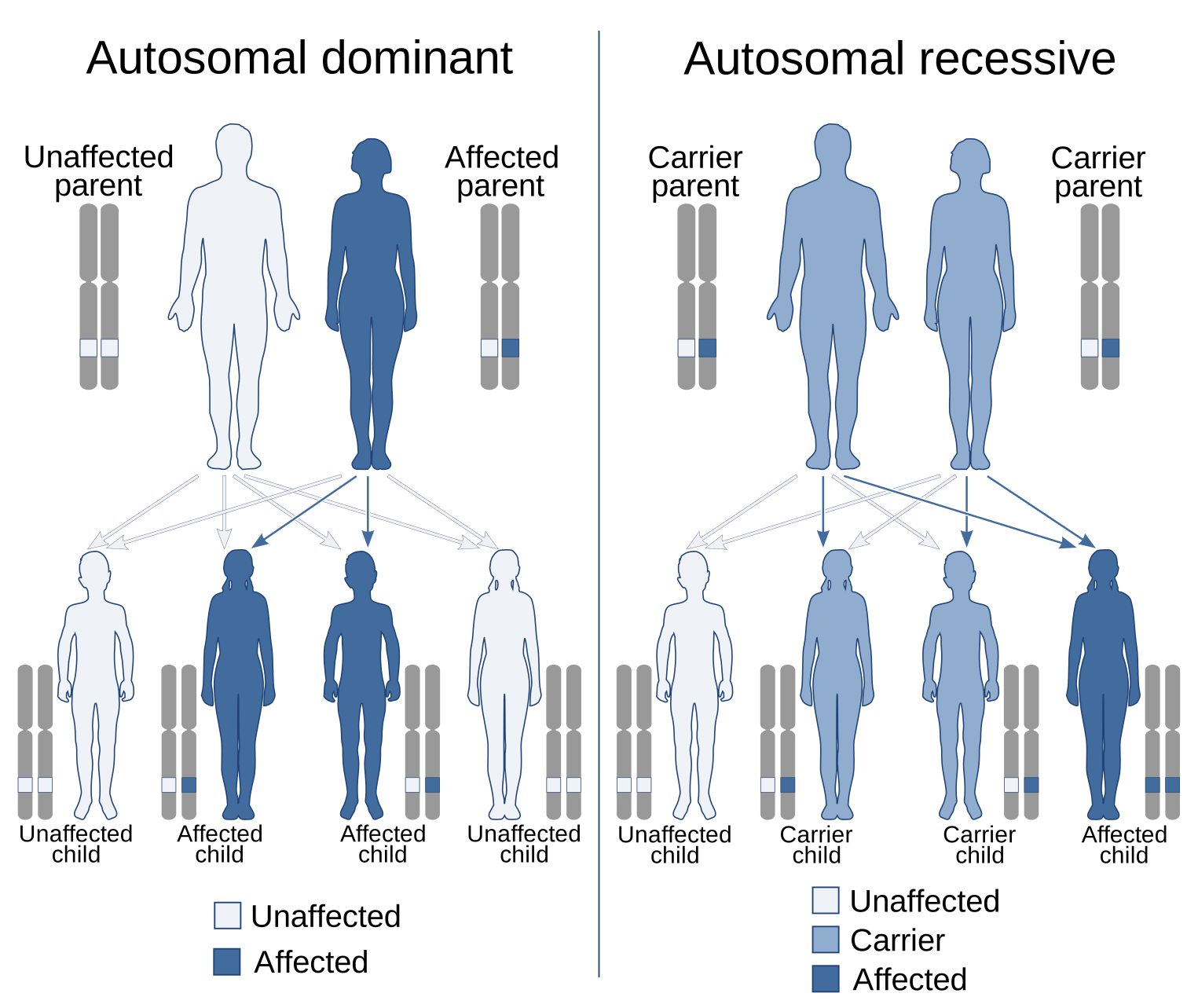
Autosomal dominant inheritance operates on a simple, yet profound, principle: one altered gene copy is enough. Genes reside on chromosomes, and humans typically have two copies of each autosome (chromosomes 1 through 22), one inherited from each parent. In autosomal dominant inheritance, a mutation in just one of these two copies of a specific gene is sufficient to express the associated trait or disorder. This means an affected individual usually has one parent who is also affected, and each child has a 50% chance of inheriting the mutated gene and thus the trait. The unaffected gene copy, while present, does not compensate for the function lost or altered by the mutation. This pattern is distinct from autosomal recessive inheritance, where both gene copies must be mutated for the trait to manifest, and from sex-linked inheritance, which involves genes on the X or Y chromosomes.
📊 Key Facts & Numbers
Globally, autosomal dominant conditions affect a substantial portion of the population. For instance, Marfan syndrome, a connective tissue disorder, affects roughly 1 in 3,000 to 1 in 5,000 live births. Neurofibromatosis type 1 (NF1), a condition causing tumors to grow on nerve tissue, has a prevalence of about 1 in 3,000 individuals. Familial hypercholesterolemia (FH), a common cause of premature heart disease, affects approximately 1 in 250 individuals when considering heterozygous cases (one mutated copy). The penetrance of autosomal dominant genes can vary; for example, Huntington's disease has nearly 100% penetrance, meaning most individuals who inherit the mutation will develop the disease, typically between ages 30 and 50, while other dominant conditions might have reduced penetrance, where not everyone with the mutation shows symptoms.
👥 Key People & Organizations
Pioneers like Gregor Mendel, whose work on pea plant inheritance in the 1860s laid the foundation for understanding genetic transmission, are central to the history of dominant inheritance. Later, Thomas Hunt Morgan and his students at Columbia University in the early 20th century were instrumental in linking Mendelian inheritance to chromosomal theory. In clinical genetics, figures like George Huntington, who described the hereditary nature of the neurological disorder bearing his name in 1872, provided early human examples. Modern research relies heavily on organizations like the National Institutes of Health (NIH) and the European Molecular Biology Laboratory (EMBL), which fund and conduct research into the genetic underpinnings of these conditions. The Human Genome Project, completed in 2003, has been pivotal in identifying specific genes responsible for numerous autosomal dominant disorders.
🌍 Cultural Impact & Influence
The concept of autosomal dominant inheritance has profoundly shaped our understanding of heredity and disease, moving from abstract principles to tangible genetic diagnoses. It has fueled the development of genetic counseling services, enabling families to understand their risk and make informed reproductive decisions. The identification of dominant genes has also driven the creation of patient advocacy groups, such as the National Organization for Rare Disorders (NORD) and the Huntington's Disease Society of America (HDSA), which provide support and promote research. Culturally, the idea that a single gene can dictate a person's health destiny has permeated literature and film, often exploring themes of fate, inherited responsibility, and the ethical dilemmas surrounding genetic predisposition, as seen in narratives surrounding conditions like Huntington's disease.
⚡ Current State & Latest Developments
The current landscape of autosomal dominant inheritance research is characterized by rapid advancements in gene sequencing and gene editing technologies. The widespread adoption of next-generation sequencing (NGS) allows for the rapid and cost-effective identification of mutations responsible for dominant disorders, leading to quicker diagnoses. For example, researchers at Broad Institute and Massachusetts General Hospital reported significant progress in using CRISPR-Cas9 gene editing to correct mutations causing dominant conditions in preclinical models. Furthermore, the development of antisense oligonucleotide (ASO) therapies, such as those used for Spinal Muscular Atrophy (though not exclusively dominant), demonstrates a growing therapeutic avenue for directly targeting gene expression. The ongoing expansion of large-scale genomic databases, like DisGeNET and ClinVar, continuously refines our understanding of genotype-phenotype correlations for thousands of autosomal dominant variants.
🤔 Controversies & Debates
One of the most persistent debates in autosomal dominant inheritance revolves around the concept of penetrance and expressivity. While the 50% inheritance risk is a statistical certainty for a population, individual family members may exhibit varying degrees of symptoms or even no symptoms at all, despite carrying the mutation. This variability, known as reduced penetrance or variable expressivity, raises ethical questions in genetic counseling, particularly when a mutation is identified but its clinical manifestation is uncertain. Another area of contention involves the interpretation of variants of unknown significance (VUS) identified through genetic testing, where the precise impact on health remains unclear, leading to potential patient anxiety and diagnostic uncertainty. The development of gene therapies also sparks debate regarding accessibility, cost, and long-term efficacy, as seen with treatments for conditions like achondroplasia.
🔮 Future Outlook & Predictions
The future of understanding and managing autosomal dominant inheritance is poised for significant transformation. Advances in gene therapy and gene editing technologies like CRISPR hold the promise of correcting causative mutations directly, potentially offering cures rather than just symptom management for many conditions. Precision medicine approaches will increasingly tailor treatments based on an individual's specific genetic profile and the precise mutation they carry. We can anticipate a surge in the identification of novel autosomal dominant genes through large-scale population sequencing initiatives, further expanding the diagnostic spectrum. Furthermore, the integration of artificial intelligence in analyzing complex genomic data will accelerate the discovery of genotype-phenotype relationships and predict disease progression with greater accuracy, potentially leading to earlier interventions and improved patient outcomes.
Key Facts
- Category
- science
- Type
- topic