
Contents
Overview
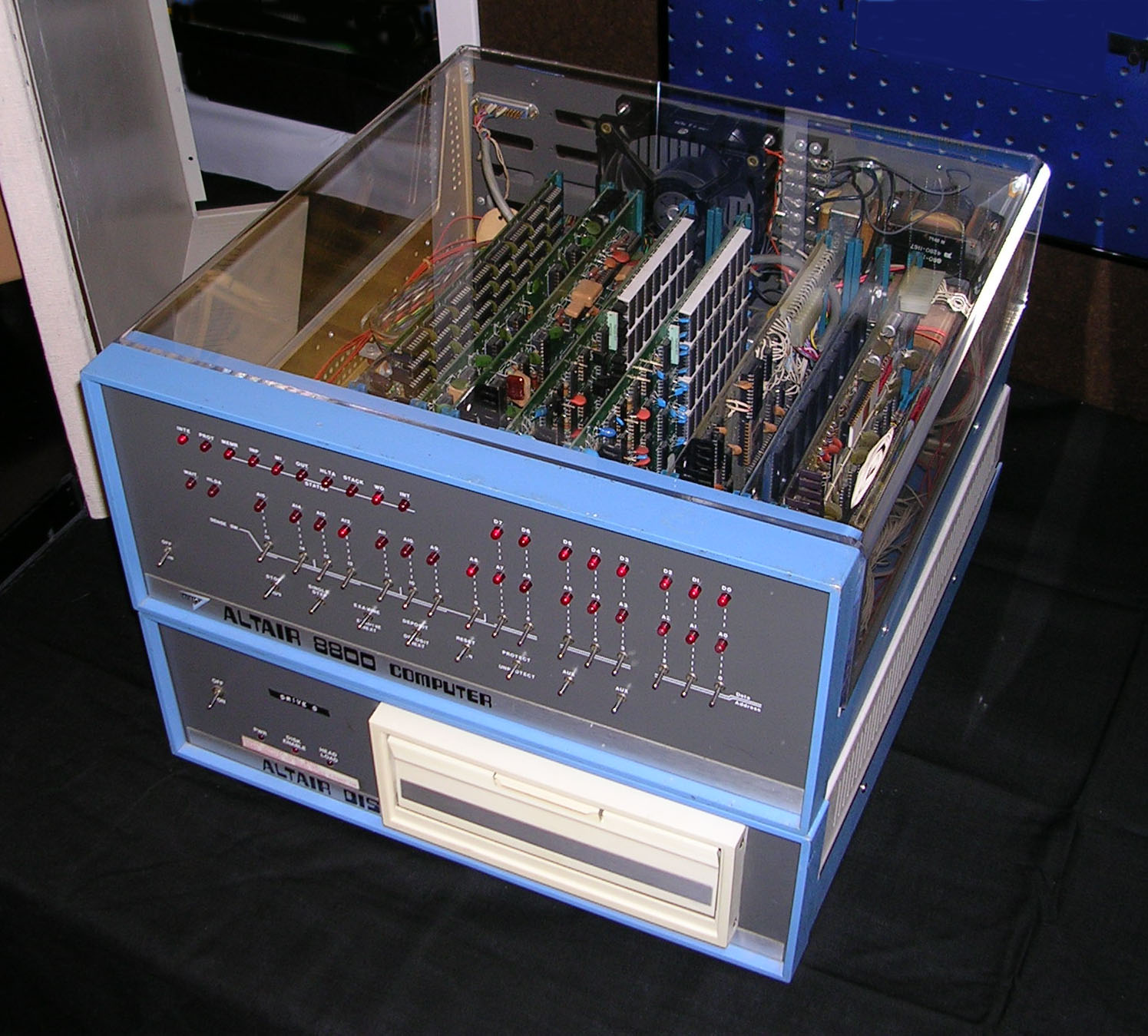
The Altair 8800, launched by Micro Instrumentation and Telemetry Systems (MITS), stands as a monumental artifact in computing history. This microcomputer, powered by the Intel 8080 CPU, is widely credited as the first commercially successful personal computer, transforming hobbyist electronics into a burgeoning industry. Its appearance on the January 1975 cover of Popular Electronics magazine ignited a wildfire of interest, leading to over 10,000 units sold via mail order. Lacking integrated display or keyboard, users interacted with the Altair 8800 through front-panel switches or by connecting it to a serial terminal, a testament to its early, utilitarian design. The bus architecture developed for the Altair, the S-100 bus, became an industry standard, further cementing its legacy. The Altair 8800 wasn't just a machine; it was a catalyst, a tangible representation of computing power finally accessible to individuals, ushering in the era of the personal computer revolution.
🎵 Origins & History
The genesis of the Altair 8800 can be traced back to Ed Roberts and his company, Micro Instrumentation and Telemetry Systems (MITS), in Albuquerque, New Mexico. Roberts, initially focused on calculators, saw an opportunity in the burgeoning market for microprocessors. The Altair 8800 was designed as a kit computer, intended to be affordable for electronics hobbyists. Its debut in the January 1975 issue of Popular Electronics was a masterstroke, featuring the machine prominently on its cover. This single act of exposure, orchestrated by editor Les Solomon, transformed MITS from a niche electronics supplier into the epicenter of a new technological movement. The initial demand far outstripped MITS's production capacity, with over 1,000 orders flooding in within the first month, a staggering figure for a mail-order kit computer at the time. This overwhelming response validated Roberts's vision and set the stage for the microcomputer revolution.
⚙️ How It Works
At its core, the Altair 8800 was built around the Intel 8080 microprocessor, a significant piece of silicon that provided the computational muscle. Unlike modern computers with integrated displays and keyboards, the Altair 8800 featured a front panel adorned with switches and lights. Users programmed the machine by flipping these switches to input binary code, and the lights would display the results. For more practical interaction, an optional serial interface card allowed connection to teletype machines or other serial terminals, providing a more conventional input/output method. The machine's expansion capabilities were facilitated by its innovative bus design, which would later be standardized as the S-100 bus. This modular approach allowed hobbyists to add memory, I/O ports, and other peripherals, significantly extending the machine's functionality beyond its basic configuration.
📊 Key Facts & Numbers
The Altair 8800 sold for an introductory price of $439 in kit form, equivalent to approximately $2,500 in 2023 dollars, making it an accessible entry point into computing for many. Within the first six months of its announcement, MITS received over 1,000 orders, and by the end of 1975, sales had surpassed 5,000 units. By 1976, MITS reported selling over 10,000 Altair 8800 systems. The machine's success spurred the creation of numerous third-party peripheral manufacturers, with estimates suggesting that the market for Altair-compatible hardware quickly grew into the tens of millions of dollars annually. The Intel 8080 CPU it utilized was priced at $360 in single quantities, highlighting the cost-effectiveness of the Altair's overall package.
👥 Key People & Organizations
The driving force behind the Altair 8800 was Ed Roberts, the founder of Micro Instrumentation and Telemetry Systems (MITS). Roberts's vision for an affordable microcomputer kit was crucial to its conception and success. Les Solomon, the editor of Popular Electronics, played a pivotal role in bringing the Altair 8800 to public attention by featuring it on the magazine's cover, a decision that catalyzed its widespread adoption. Early software development was significantly influenced by Bill Gates and Paul Allen, who developed Altair BASIC, the first high-level programming language for the machine, through their nascent company Microsoft. Other key figures include Harry Garland, who recognized the Altair 8800 as the product that catalyzed the microcomputer revolution, and Lee Felsenstein, who designed the improved Altair 8800b and later chaired the Homebrew Computer Club meetings.
🌍 Cultural Impact & Influence
The Altair 8800's cultural impact is immeasurable, effectively launching the personal computer industry. Its availability as a kit democratized computing, transforming it from a domain of large corporations and research institutions into a hobbyist pursuit. The machine inspired a generation of programmers and entrepreneurs, most notably Bill Gates and Paul Allen, whose development of Altair BASIC for the Altair 8800 marked the founding of Microsoft. The computer's bus architecture, the S-100 bus, became an early industry standard, fostering a vibrant ecosystem of compatible hardware. The machine's success also led to the formation of user groups like the Homebrew Computer Club, which became incubators for further innovation, including the development of the Apple I by Steve Wozniak and Steve Jobs.
⚡ Current State & Latest Developments
While the Altair 8800 itself is a historical artifact, its legacy is actively maintained through emulation and retrocomputing communities. Enthusiasts and historians meticulously preserve original hardware and software, with projects like the Altair emulator allowing modern users to experience its unique interface. The Computer History Museum and similar institutions house working Altair 8800 units, ensuring their preservation for future generations. The principles of modular design and open architecture pioneered by the Altair 8800 continue to influence modern computing, albeit in vastly more sophisticated forms. Discussions around its historical significance and technical achievements remain active within academic circles and hobbyist forums.
🤔 Controversies & Debates
A primary debate surrounding the Altair 8800 centers on its true status as the "first" personal computer. While undeniably the first commercially successful one, earlier experimental or limited-release machines existed. Another point of contention, though less technical and more historical, is the extent to which Ed Roberts foresaw the full implications of his creation versus simply capitalizing on a hobbyist market. Furthermore, the transition from kit to assembled units, and the subsequent rise of more user-friendly machines like the Apple II and Commodore PET, raises questions about the Altair's long-term viability as a mainstream product versus its role as a foundational stepping stone. The development of Altair BASIC by Microsoft also sparks discussions about the early dynamics of software development and its commercialization.
🔮 Future Outlook & Predictions
The future of the Altair 8800 lies not in direct technological advancement, but in its continued role as an educational and inspirational tool. Retrocomputing enthusiasts will likely continue to refine emulators and develop new software for historical platforms, keeping the Altair 8800 alive in spirit. Its story serves as a perpetual case study in innovation, entrepreneurship, and the power of accessible technology. Future historical analyses may further illuminate the precise economic and social conditions that allowed the Altair 8800 to capture the public imagination so effectively. The enduring fascination with the Altair 8800 suggests its narrative will remain relevant in discussions about technological disruption and the democratization of complex tools.
💡 Practical Applications
The most significant practical application of the Altair 8800 was its role as a platform for learning and experimentation. For hobbyists in the 1970s, it provided a tangible way to understand computer architecture, programming, and hardware interfacing. It served as the foundation for countless early software projects, including operating systems, games, and utility programs, many of which were developed by individuals who would go on to shape the tech industry. The development of Altair BASIC by Microsoft was a direct practical outcome, enabling a wider range of users to program the machine. Beyond its direct use, the Altair 8800's design principles influenced the development of subsequent computer systems, making it a practical blueprint for future innovations in personal computing hardware and bus architecture.
Key Facts
- Category
- technology
- Type
- topic